The economics of disinformation are simple enough to write on a napkin. Costs of production must be lower than the political or commercial value extracted. Pre-internet, disinformation production required a newsroom-style apparatus: writers, editors, distribution. Costs were high; only well-resourced state and corporate actors could sustain operations at scale.
The internet halved the costs by removing distribution. Social platforms cut them again. Generative AI cuts them once more, by removing the writers.
This is the structural change. Everything else follows from it.
What the change actually means
A 2023 RAND / OpenAI joint report on automated influence operations modeled the new economics in detail.1 Their summary: a single operator with modern generative tools can produce, at near-zero marginal cost, content streams that previously required newsroom investment. The volume is bounded only by the operator’s distribution capacity, not by their writing capacity.
This means three operational shifts.
Volume. Disinformation campaigns can now flood a topic — generating hundreds of articles, posts, and replies per day on a narrow topic — at a cost that twenty years ago would have produced a single weekly newsletter.
Tailoring. Each article can be customized to a specific audience, in specific phrasing, on specific platforms, in different languages. The generic-to-specific multiplier is roughly model-output ratio.
Layered laundering. Fake news is more credible if it appears on multiple sources rather than one. Generative tools allow a single operator to seed the same story across dozens of plausible-looking outlets, then have it “picked up” by social media — creating an apparent ecosystem from a single source.
Each shift is operationally significant. Together, they restructure the information environment.
What it doesn’t necessarily mean
Important corrective: disinformation has always been less powerful per piece than alarmist commentary suggests. Allcott and Gentzkow’s 2017 study of fake news in the 2016 U.S. election found that the average American adult had been exposed to one or a few fake news stories during the campaign, but that the persuasive effect of any given story was small.2 People are more resistant to disinformation than the volume of it suggests.
The corrective matters because the policy response to “AI makes disinformation cheap” depends on what the elasticity of harm is. If disinformation harm is mostly in the volume — saturating attention, drowning genuine reporting — then volume reduction is the right target. If it is in the per-piece persuasion — convincing someone of a specific false thing — then volume reduction matters less and per-piece detection matters more.
The current literature’s best guess: harm is dominantly volume-mediated, with specific high-stakes pieces (election-eve deepfakes, viral medical misinfo) mattering disproportionately. The right responses target both.
Volume responses
Source-level detection. Identify content farms by behavioral signatures (posting cadence, account age clustering, etc.) and demote or remove them. Platforms have invested heavily here; the arms race continues.
Watermarking. Embed signals in AI-generated content that allow detectors to flag it downstream. The labs have started doing this; the marks are fragile against determined attack and don’t survive screenshots.
Provenance standards. Build cryptographic provenance into media at the camera level (C2PA, Content Authenticity Initiative). Slow but real progress.
Per-piece responses
Verification literacy. The skills needed to evaluate a specific suspect piece — find the original source, check the date, reverse-image-search the photo, look for corroborating reports. These skills are teachable. They are not currently widespread.
Friction at sharing. Prompts that interrupt a share with “have you read this?” or “this article is from a low-credibility source.” Modest but measured effect on viral propagation.
Independent fact-checking. Underfunded, frequently politically attacked, genuinely useful when reaching the audiences who need it. Most of those audiences distrust the institutions that fund fact-checking, which is part of the larger problem.
Where this connects
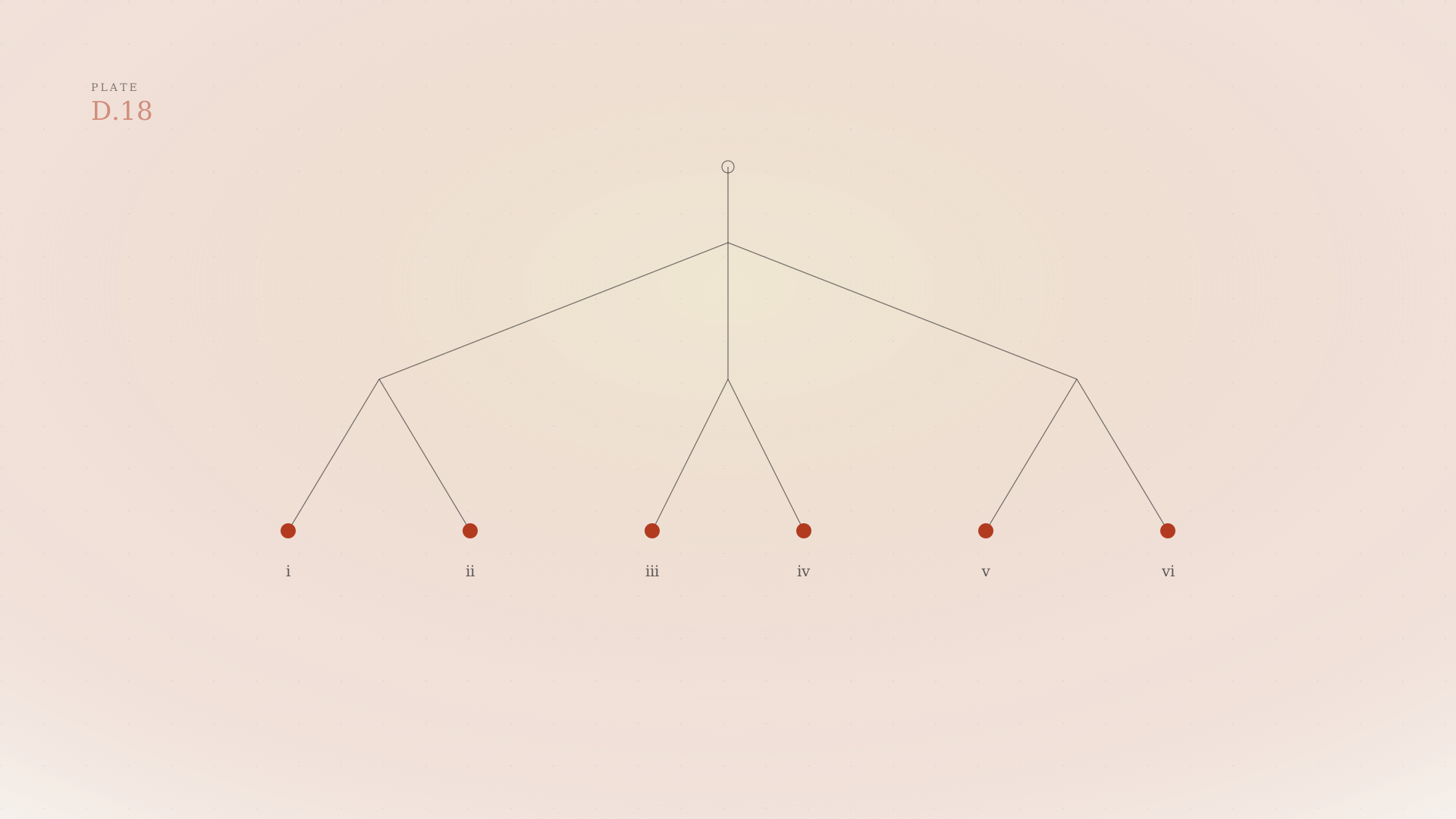
Disinformation at scale is one of the cells in the manipulation taxonomy (D.18) and one of the most concretely measurable. Deepfakes (D.22) takes up the audio-visual variant. Manipulation of Perceived Reality (D.23) considers the deeper question — what happens to shared reality when all of these techniques become routine — and Ethical Safeguards (D.24) sketches the regulatory and design responses.
The encyclopedia’s stance, consistent with the section’s larger argument: disinformation is not new. AI did not invent it. What AI did was lower the cost of production by an order of magnitude, which restructures the information environment in ways that institutions designed for higher costs are not currently equipped to handle. The work of redesigning those institutions is the work the next decade will mostly do.