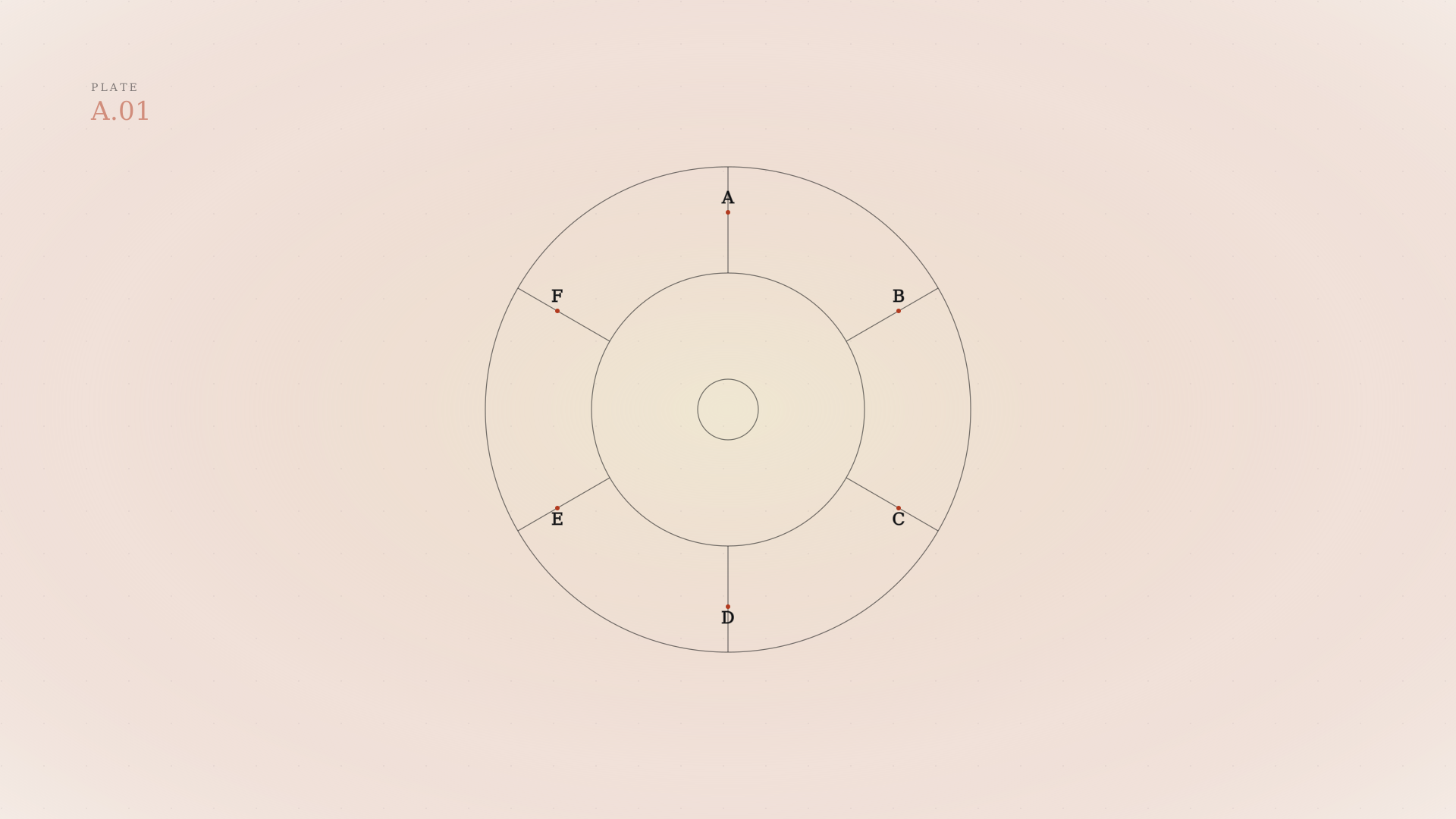
This encyclopedia gathers, in forty entries, the conceptual material of Rénald Gesnot’s The Impact of Artificial Intelligence on Human Thought (arXiv:2508.16628, 2025). Gesnot’s argument runs across eight chapters, in the linear shape of a monograph. We have rearranged it as a wiki of self-contained pieces, each readable on its own and linked to its neighbors.
What’s here
Forty articles, grouped into six sections, identified by letter and order:
- A. Foundations — what AI is, what cognition is, how the two meet in 2025.
- B. Cognition & Offloading — the conceptual spine, after Sweller and Risko & Gilbert.
- C. Standardization — the homogenization risk: language, style, opinion, culture.
- D. Manipulation — a taxonomy of how AI can shape human decisions, often invisibly.
- E. Consciousness — the question of machine minds, and the black-box problem that surrounds it.
- F. Power & Governance — what states and corporations are already doing with these tools, and what one might do about it.
Each article carries a plate number like B.07 (section letter, two-digit
order). The plate number is stable across all four languages — it is the only
identifier guaranteed not to change when you switch between English, Russian,
Hebrew, or Amharic.
How to read it
Three approaches, depending on what you came for.
- Wander. Pick a section door from the front gallery and follow your eye. Every article ends with a See also rail of three siblings; the rails form a graph that you can drift through indefinitely.
- Drill in. If you came with a term in mind — cognitive offloading, filter bubble, deepfake, Integrated Information Theory — use search (Cmd-K from any page) or the glossary. Each glossary entry lists the articles in which the term appears.
- Take a tour. The Reading Paths surface curated sequences of five to twelve articles. The Short Tour is the obvious entry for first-time visitors; The Cognition Track and The Manipulation Track reward a slower second visit.
Editorial method
Articles are adapted from Gesnot’s monograph but written in the encyclopedia’s own voice. Where the paper says one thing in 2,000 words, we may say it in 800; where the paper assumes the reader has already read the previous chapter, we restate what’s needed. Citations are preserved in their original numbering; passages we have compressed or simplified are marked with a curator’s note in the margin.
Two kinds of articles live here. Most are adapted from a specific section of the paper — these carry a footer line of the form “Adapted from §X.Y.” A small number are editorial commentary: framing pieces, like the one you are reading now, that exist to make the wiki navigable. These are marked accordingly. The distinction matters: the paper is Gesnot’s; the encyclopedia is the encyclopedia’s.
Why an encyclopedia, and not just the paper
A monograph is a long line; an encyclopedia is a graph. The two formats reward different kinds of attention. A line gives you the author’s argument, in order, as they intended it to land. A graph gives you a topology — you arrive at cognitive offloading from transactive memory, or from filter bubbles, or from deepfakes, depending on what you were chasing, and the article looks slightly different each time because of what you bring to it.
Gesnot’s monograph is the line. We recommend reading it first if you can — it is freely available on arXiv. This encyclopedia is the graph: the same material, laid out for return visits.
Languages
Four locales: English, Русский, עברית, አማርኛ. English is the source-of-truth; the other three are translated with machine assistance and human review. Articles awaiting review carry a small italic notice. We are honest about provenance.
A note on the imagery
Every article carries a hero image. All are AI-generated from a single prompt
template that produces the warm-toned, vaguely-archival look you see throughout.
Provenance is logged at /about/methodology — including the exact prompt for each
plate. We treat machine-generated imagery the same way we treat machine-generated
prose: useful, transparent, attributed.
The encyclopedia is, in this small way, a demonstration of its own subject.